Lately I keep getting asked the same question: "I've had my Zi Wei chart read, I've read plenty of astrology books — why would I need Vedic astrology on top of that?"
The people asking are usually not beginners. Quite the opposite — they're the ones who have done their homework, often gone through plenty of healing work, and still have one or two issues that just won't come loose.
I used to be an engineer, and my instinct with a question like this is: first figure out the spec of each tool. They all "read a chart," but these systems are actually answering different questions. Once you understand that, you'll know which one you need right now — or that, honestly, you might not need any of them.
First, something most people aren't clear about
Western astrology and Vedic astrology define the sky differently.
Not as a metaphor — literally. Western astrology uses the tropical zodiac, anchored to the spring equinox; Vedic astrology uses the sidereal zodiac, aligned with the actual fixed stars. Because of the slow wobble of the Earth's axis (precession), these two coordinate systems have drifted about 23–24 degrees apart by now. Which means the sun sign you know from Western astrology will very likely slide back one sign in a Vedic chart.
The first time people hear this, they tend to feel slightly offended: "So I'm not a Leo?"
You're both. The two systems are simply measuring different things — like Celsius and Fahrenheit. The numbers differ, but both describe temperature. The real difference isn't the coordinates. It's what question each system brings to the star map.
What follows is my own take from working with these systems. I might be wrong about some of it — happy to hear other views.
Three systems, three questions
Modern Western astrology asks: "Who am I?"
After its encounter with psychology, modern Western astrology centers on personality, inner drives, and relationship patterns. It's very good at describing you to yourself — why you always give way first in relationships, why you need to feel affirmed. Reading it feels like being understood. (Classical Western astrology is a whole other discipline... a story for another time.)
Zi Wei Dou Shu asks: "What's the shape of my life?"
Zi Wei casts its chart from the lunar calendar birth data — twelve palaces, stars, the four transformations — and reads structure and trajectory: how strong your career palace is, what each ten-year cycle brings. It's like a sandbox model of a whole life, highly structural. Taiwanese people know it well, partly because it speaks our everyday worries directly: career, wealth, marriage, property.
Vedic astrology asks: "What did I bring with me, and where am I on the road?"
The underlying logic of Vedic astrology is karma — not the dramatic "payback" version, but something closer to karmic momentum (samskara): the patterns, lessons, and resources you entered this life carrying. And then it has something no other system has: the Dasha system of planetary periods. It tells you directly which planet is "on duty" in which chapter of your life, and which themes will be pushed in front of you.
So: Western astrology excels at describing what kind of person you are, Zi Wei excels at modeling how your life is structured, and Vedic astrology excels at answering what your karmic momentum is — and when, and how, it can be loosened.
A little more on Vedic astrology: what actually makes it different
Since it's the main character here, let me cover two things that are uniquely its own.
First, the twenty-seven Nakshatras.
Beyond the twelve signs, Vedic astrology divides the zodiac into twenty-seven finer "lunar mansions," each with its own character, themes, and mythology. So two people with the Moon in the same sign, but in different nakshatras, will read very differently. This gives Vedic astrology far higher resolution than "what's your sign" — like going from 720p to 4K. Same picture, but now you can see the detail.
Second, it doesn't just diagnose — it prescribes.
This is the main thing that drew me in. Most systems, after reading your chart, hand you a description: "You have authority issues." "You tend toward inner friction." The description may be accurate — but accurate isn't the same as knowing what to do.
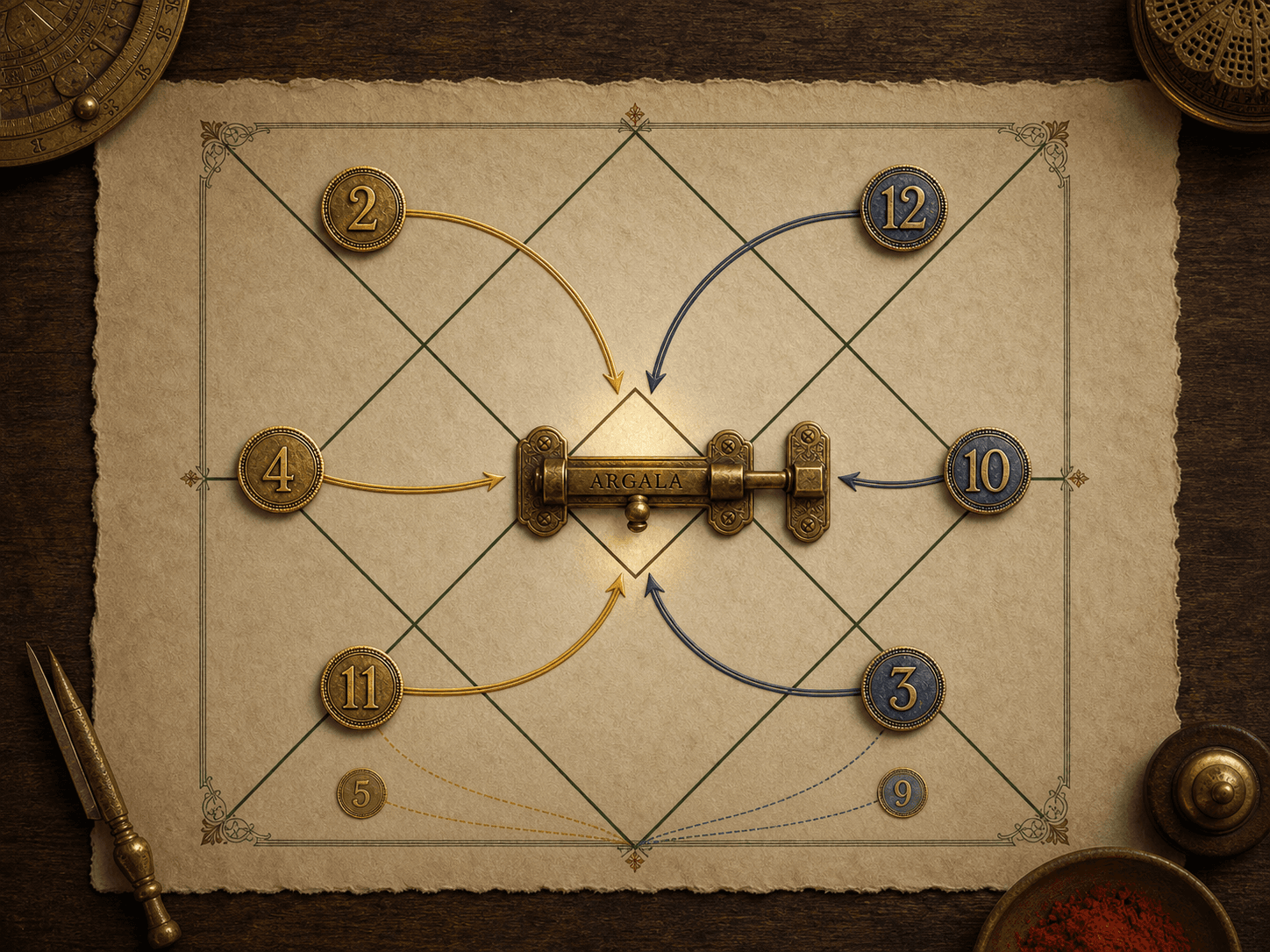
Vedic astrology carries a whole tradition of remedies (Upaya) — concrete, daily-life countermeasures based on your chart. A classic teaching example: in Vedic astrology, the father is represented by the Sun. What is the Sun? Blazing, immovable. If your issue with your father feels like fighting the Sun head-on, charging at it will only get you burned — but you can stay out of the sun, find shade, and remember that the sun does set. That's not avoidance; it's a different strategy for coexisting with that force. The remedies themselves are often surprisingly plain: spending time near water at certain periods, adjusting a daily habit. Nothing mystical — but done in alignment with the chart, you feel it. Yoga counts as a remedial practice too, as does pairing it with Ayurvedic dietary therapy — balancing your own energy so you become steadier and less swayed by what's outside you.
I recently finished a 40-day mantra practice myself, and the shift was tangible. My teacher also suggested I chant the mantra 108 times a day, to keep loosening my own karmic momentum.
So Vedic astrology, together with the wider body of Vedic knowledge, can be used as a remedial path in itself — and I find that genuinely practical. When I tried Zi Wei and Western astrology, their predictions were good, but neither gave me anything to do about them. Knowing something might happen and then... what? That "and then what?" is exactly the gap.
A side note: Arabic astrology (which seems about to have a moment)
People occasionally ask, so briefly: in the medieval period, Greek astrology passed into the Arab world, where Persian and Arab astrologers refined it considerably before it traveled back to Europe — today's Western astrology actually has this "Arabic relay station" in its lineage. Its most famous legacies are the Arabic Parts and a mature tradition of horary astrology: instead of your birth chart, it reads the sky at the moment you ask a question, and answers that specific question. Interestingly, Vedic astrology has its own horary branch (Prashna) — these old systems traded ideas far more than we tend to imagine.
So — which one do you need?
Old engineering habit: end with a decision tree.
- You want to understand your inner patterns better → Western astrology gives you the richest language.
- You want the structure and broad direction of your life → Zi Wei has the most complete framework, told in an Eastern vocabulary.
- You want to see karmic momentum, spiritual gifts, and life structure — the root of an issue and its timing → this is Vedic astrology's home ground.
- You have one very concrete yes-or-no, will-it-work question → horary (Arabic, or Vedic Prashna) fits better than a birth chart.
And there's one more case: if you're simply worn out lately and want someone to talk to — then honestly, what you need may not be any chart at all, but a stretch of time in which you're properly heard.
I don't think any system is "the most accurate." They're different tools, showing you different faces of yourself. Having walked the circuit, I ended up going deepest with Vedic astrology — because what it offers isn't just description, but strategy and a sense of timing. For an engineer, that's something I can actually work with.